
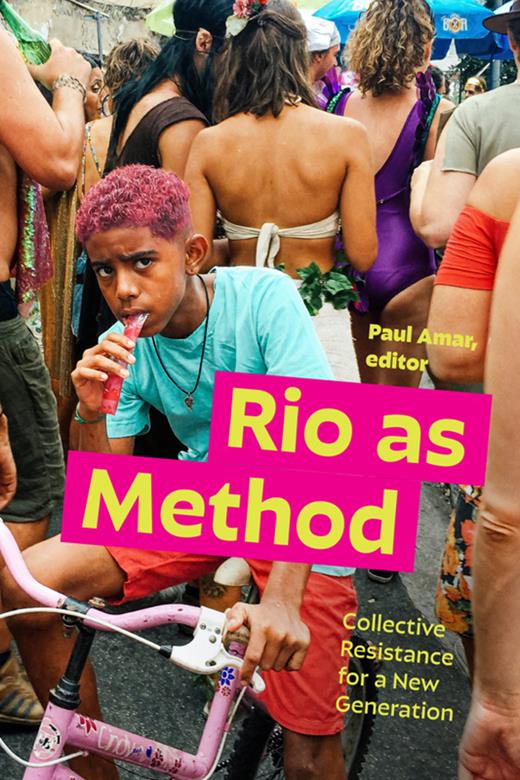
Rio as Method: Collective Resistance for a New Generation, edited by Paul Amar, 2024, Duke University Press
Deadly militias no longer represent a parallel power structure in Rio de Janeiro—for all intents and purposes, they are the power structure.
These paramilitary mafias have extended their grip across the metropolis of 14 million people like a vast, insatiable octopus, in some cases ruling openly in quasi-statelets.
While notionally illegal, they simultaneously conduct their criminal activities alongside strategies of legitimation, gathering protection taxes, providing infrastructure, and acting as de facto law enforcers—especially in the most marginalised, usually Black, areas of the city.
Dominated in their origin and composition by current and former state security agents—a legacy of the death squads of the 1990s and of ties to the worst elements of the police—there are nonetheless also vigilante groups wholly dedicated to organised crime, particularly drug-trafficking.
The most important development of this phenomenon has been the degree to which militias have penetrated the state, and hence their close association with politicians and all-pervasive influence as power-brokers.
Sociologist José Cláudio Alves, a professor at the Federal Rural University of Rio de Janeiro who has studied this topic extensively, argues that the influence of militias now extends beyond managing illegal markets and reaches deep into the realms of political power.
A vector of this spreading influence has been rapid, unfettered urbanisation, enabling militias to mediate between authorities, residents and markets to resolve the common lack of infrastructure and services, thereby accruing political capital to expand their sway.
This has created an intimate association between territorial control and political power—especially on the right of the spectrum—with militias able to deliver electoral outcomes and, increasingly, nurture political leadership.
Yet there is little novel about this form of control in Brazil, Alves notes in Rio as Method, pointing to the colonial origins of what he terms “militiarchy”: the use of armed groups both of and outside the state to expand a structure of power that maximises capitalist accumulation.
In a colonial slave society with vast territorial expanses, this characterised the evolution of a very particular form of state control, yet it persists to this day in the informal but nonetheless significant relationship between legal and illegal armed groups.
Alves writes: “The coexistence of distinct forms of violence and exploitation is notably geared toward Black Brazilians and slum dwellers. Initiated during the colonial period, this violence continued to be practised by current militias to the advance of today’s extreme right.”
Alves traces the evolution of militias to a dominant position in Rio by 2020, arguing that they are now more powerful and widespread than the police, and span the lower-middle class and working-class neighbourhoods of about half the megacity.
They are, nonetheless, quasi-formal structures maintaining a tight relationship to the formal exercise of legitimate violence, with their seeming novelty merely concealing an historical “racial-colonial continuity”.
Alves writes: “As the offspring of death squads created in the late 1960s … militias evolved as a political structure created by the state, not as a voluntaristic invention by community groups who came together to protect themselves.”
The murder of the late city councillor and Black feminist Marielle Franco in 2018 against the backdrop of the rise of the extreme right in Rio’s politics provided a context for taking stock of the militias in an atmosphere of resurgent racialised violence with colonial origins, especially in large working-class communities such as Baixada Fluminense.
As Alves argues, over the last five decades Rio has become a laboratory for militia-based forms of racialised rule, violently reestablishing “supremacist and genocidal doctrines of control” in a political system to which he assigns the neologism “recolonial militiarchy”.
This original and creative approach to a key aspect of chaotic expansion is recreated throughout Rio as Method, which brings together highly innovative sociological perspectives in the study of the city’s progressive coming of age. The book compiles a range of essays with an unashamedly decolonial flavour that explore dynamic and experimental forays into the quest for answers to social ills.
Together its 30 contributions, writes editor Paul Amar, offer a set of new methods for identifying sociopolitical problems and devising frameworks for progressive ways to solve them. It is a testament to Rio’s position as a unique experimental “hub of transformational thought or action” and a manifesto for the “epistemological turn” identified by Puerto Rican sociologist Ramón Grosfoguel which is, literally, inverting the global academy.
Like much of the scholarship now coming out of Latin America, Rio as Method comprises a bold assertion of the region’s growing stature as a source of new knowledge and ideas—no longer merely the object of scholarship seen through the tired eyes of the Global North.
Indeed, we can all recognise in the phenomena characterising the unique development of a messy, unforgiving modernity in this city elements of our own experience: Rio is almost becoming the archetype for what all of us can expect.
From Indigenous epistemologies to “travestirevolutionism” and “puta politics”, the book’s explicit aim is to empower local knowledge production by resisting the “intellectual appropriation and extractivism” that has hitherto characterised scholarship. New concepts are littered throughout to challenge mainstream, normative agendas.
Rio as Method proceeds in four sections that explore the state, seeking new activist logics for remaking governance; space, exploring new ways of mapping the city’s racial, gendered and criminal dynamics; subjects, where author-activists consider the panoply of identities that now compete to be heard; and “futurity”, in which contributors imagine worlds yet to come.
Moving contributions include an opening essay by Franco, killed by members of a militia who were former state security officers. Her death sparked outrage and serves as a tragic illustration of the racialised violence captured in Alves’s concept of “militiarchy”.
An outspoken critic of police brutality and extrajudicial killings—which explains why she was targeted—Franco’s contribution imagines a Rio that moves away from the muscular, militarised security that has created conditions of a permanent war in citizens’ lives.
She articulates the spirit of those pressures that have been growing for a new form of democracy in Brazil—and, increasingly, elsewhere—based upon citizen self-empowerment and self-governance.
The Franco case also draws attention to how Rio’s unique development turned it into something of a cradle for a depressing new species of hard-right populism that explicitly celebrates this kind of targeted violence against a Black woman.
As the editor notes, many notorious militia commanders have been directly linked to politicians in the city, which was the crucible in which Jair Bolsonaro, the former president and a former Rio councillor, forged his movement.
It is to Rio’s great credit that as well as unwittingly being the vessel in which the virus represented by Bolsonarismo gained life, as witnessed by the contributors to this book the city has also become the source of imaginative vaccines against it.
Amar writes: “But this reality—of Rio as an incubator for Bolsonarismo and other previous and subsequent far-right sociopolitical trends—has not severed it from the global imagination nor purged the city of its spaces and histories of progressive struggle.”
Read this and receive articles straight to your inbox by subscribing on Substack
Categories: Brazil, South America